
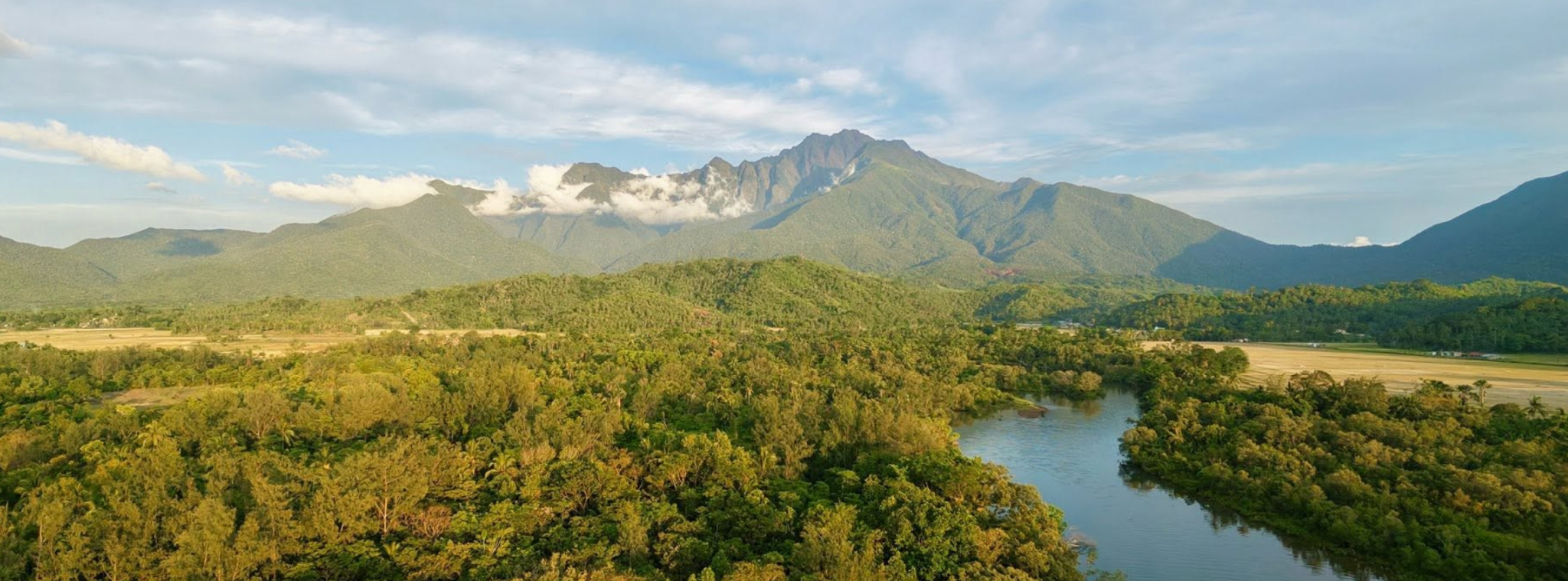
Photo: Justin Mayor
Home is Sibuyan.
An island in Romblon, in the middle of the Philippines, where mountain, forest, river, farm, and sea are never very far from one another.
I grew up close to the baybay. Behind it are the communities, the fields, the rivers, and farther inland, the mountains and forests that hold much of the island’s water and life.
Long before ecology became part of my professional work, it was already part of everyday life.
The sea was where people fished, swam, gathered food, travelled, and watched the weather. Rivers were not lines on a map but places people crossed, depended upon, and remembered. The forest was not somewhere separate from the community. What happened in the bukid eventually reached the sayog, the farms, and the baybay.
Sibuyan taught me this connectedness before I knew the words for it.
An island that formed me
To grow up on an island is to understand both abundance and limitation.
There is beauty, but there is also distance. There are rich forests and seas, yet communities know how quickly livelihoods can become uncertain. A storm can change the shape of a coastline. A damaged watershed can be felt downstream. Decisions made far away can transform a place whose people may have had little voice in making them.
These experiences eventually shaped the way I understood development.
Development could not simply mean extracting more, building more, or producing more. It had to ask what would remain: the water, the soil, the livelihoods, the culture, the relationships among people, and the possibility that the next generation could still call the island home.
Kaguyangan
In Sibuyan, the forest is more than vegetation.
It holds water. It protects soil. It shelters extraordinary life. It sustains farms, rivers, communities, and the sea beyond the shoreline.
The old idea of kaguyangan—the wooded land, the forest, the living landscape—carries something that modern categories sometimes separate: people and nature belong to the same story.
A tree standing high in the mountains may seem distant from a fisher along the coast. But the watershed connects them.
The bukid and the baybay are part of one system.
This is one of the simplest lessons Sibuyan has given me, and one that has stayed with me wherever my work has taken me.
The struggle for the island
Sibuyan is also a place of struggle.
For decades, communities have confronted questions about mining, forests, land, water, livelihoods, local autonomy, and who has the right to decide the island’s future.
The mining issue made these questions especially visible. But the deeper issue has always been larger than a single project or company.
What kind of development is appropriate for an island?
Who carries the environmental risks?
Whose knowledge matters when decisions are made?
What happens when the economic value assigned to minerals conflicts with the ecological and cultural value of an entire landscape?
And what does consent mean when communities will live with the consequences long after investors and officials have moved on?
These questions have shaped much of my environmental work.
Bayay Sibuyanon
Much of that work has been carried through Bayay Sibuyanon Inc., alongside communities, local leaders, young people, farmers, fishers, professionals, church workers, and many others who believe that protecting Sibuyan is inseparable from protecting the dignity and future of its people.
The work has included environmental advocacy, public participation, governance, biodiversity, community education, and the long effort to ensure that decisions affecting the island are made transparently and with meaningful participation from the people who live there.
But defending Sibuyan is not only about opposing threats.
It is also about imagining what the island can become.
Beyond resistance
Sibuyan should not have to choose between environmental protection and human development.
There are other possibilities: regenerative agriculture, responsible fisheries, community-based tourism, locally rooted enterprises, renewable energy appropriate to island conditions, restoration of forests and watersheds, cultural conservation, and economic activities that keep value within communities rather than simply removing resources from them.
Conservation cannot mean freezing communities in poverty.
And development cannot mean sacrificing the ecological systems that make life on the island possible.
The task is to find a way of living where both people and place can flourish.
From Sibuyan to the world
My work has eventually brought me into national and international spaces dealing with climate change, biodiversity, extractive industries, governance, and integral ecology.
Yet many of the questions discussed in those rooms are questions I first encountered at home.
Climate change can be seen in a changing coastline.
Biodiversity is present in a forest people depend upon.
Climate justice becomes concrete when those who contributed least to a crisis carry some of its greatest burdens.
Participation becomes real when a barangay is asked whether it agrees with a project that may permanently alter its landscape.
Integral ecology is easier to understand when one has seen how a mountain, river, farm, village, and sea depend upon one another.
The global and the local are not separate worlds.
Sibuyan taught me that too.
Home
There are places we leave but never really leave behind.
Sibuyan has remained the measure against which I often understand other places. It is where many of my questions began, where much of my work continues, and where the meaning of home remains clearest.
The island is not perfect. No home is.
But its forests, rivers, mountains, communities, and seas have taught me that belonging carries responsibility.
To belong to a place is also to care for it.
And sometimes, to love a place means being willing to defend its right to remain alive.